How Affiliate Marketing Works: 10 Questions That Explain Everything
You’ve done it a hundred times. A friend asks what blender to buy. You tell them. They buy it. The company makes money. You get nothing. Affiliate marketing works by fixing exactly that, and it’s simpler than most people think.
Why Most People Get Affiliate Marketing Wrong
 Maybe you’ve heard “affiliate marketing” and thought scam, pyramid scheme, or some hustle for people with millions of followers.
Fair. There’s a lot of noise out there.
But stick with me. I’m not going to tell you what to think. I’m just going to ask you some questions. Answer them honestly, in your own head, and see where you land.
10 Questions That Show You Exactly How Affiliate Marketing Works
Question 1: Have You Ever Recommended Something You Genuinely Liked?
Think about the last time you told someone about a restaurant. Or a TV show. Or a pair of shoes that held up better than expected.
You didn’t get paid. You just shared because it was good.
Now ask yourself, why did you share it?
Because you trusted the thing. And you wanted your friend to have a good experience.
Question 2: Did That Company Make Money When Your Friend Showed Up?
The restaurant got a new customer. The streaming app got a new subscriber. The shoe brand made a sale.
Your recommendation had real dollar value to that business.
So, who captured that value? They did. Not you.
Question 3: What If the Company Paid You for That Referral?
That’s not a fantasy. Businesses do this all the time, with sales reps, referral bonuses, and partner programs.
The mechanic is old. Affiliate marketing is just the digital version of it.
You get a unique link. Someone clicks it. The company knows you sent them.
Question 4: Does an Affiliate Link Make Your Recommendation Less Honest?
You recommended the blender because it worked. That’s still true with or without a link attached.
The link doesn’t make you dishonest. It just makes the transaction trackable.
If anything, getting paid rewards you for being right, not for being misleading.
How Affiliate Marketing Makes Money: The Exact Numbers
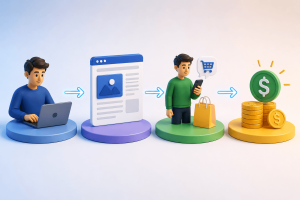
This is where most explanations get vague. Let’s be specific.
You write a blog post reviewing a $100 pair of running shoes.You include your affiliate link.
A reader clicks it, buys the shoes, the brand pays you 8% commission, and you earn $8 from that one sale.
Now imagine that post gets 5,000 readers a month. Even if just 2% buy, that’s 100 sales. That’s $800 from one article. The article keeps working while you sleep.
I’ve seen single blog posts generate consistent monthly income for years. The content does the work once. The commissions keep coming.
Question 5: Is Recommending a Product You Love Actually Dishonest?
Think about a doctor who recommends a specific medication because it worked for their patients. Or a mechanic who tells you to use a specific oil because engines last longer with it.
We don’t call those people dishonest. We call them trustworthy.
The recommendation is honest. The compensation is just the business model behind it.
Question 6: Why Do Big Companies Pay Strangers to Promote Their Products?
Because it’s cheaper than advertising, and more effective.
A TV ad costs $500,000 and reaches people who don’t care. An affiliate recommendation reaches someone already searching for that exact product.
Nike, Amazon, and Apple all run affiliate programs. According to Statista, affiliate marketing spending in the US alone exceeded $10 billion in 2024. These aren’t small companies taking a gamble. They pay because it works.
Question 7: If It Works for Billion-Dollar Companies, Is It Going Anywhere?
Businesses don’t keep paying for things that don’t produce results.
Amazon’s affiliate program has run for over 25 years. They’re not doing it out of charity.
The math works for them. Which means this is real, not a loophole about to close.
The Three People Involved in Every Affiliate Sale
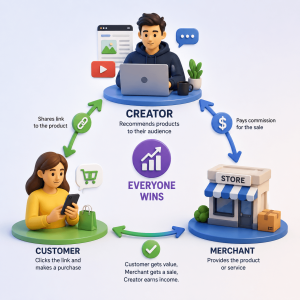 Every affiliate transaction has exactly three people.
The creator (you). You have an audience. A blog, a YouTube channel, a TikTok, or even an email list of 200 people who trust you.
The merchant (the brand). They have a product and want customers. They’d rather pay per sale than gamble on ads.
The customer (your reader). They have a problem and need a solution. Your recommendation helps them find it faster.
All three win when the recommendation is honest and the product delivers.
Question 8: If All Three People Benefit, Who Gets Hurt?
The customer gets a recommendation from someone they trust. The brand gets a sale it might not have made. You get paid for the value you created.
Walk through it slowly. Find the victim.
There isn’t one, as long as the recommendation is genuine. Fake recommendations break the whole system. Honest ones make it stronger.
Question 9: What’s the Difference Between an Affiliate Link and a TV Commercial?
A commercial is paid whether you buy or not. The brand takes all the risk.
An affiliate only gets paid when a sale happens. The brand has zero risk.
You watch a 30-second ad for a car you’ll never buy. You read an honest review of the exact product you were already searching for.
Which one actually helps you?
What is affiliate marketing, exactly? Affiliate marketing is a performance-based system where you earn a commission by recommending products through a unique tracking link. When someone clicks your link and buys, you get paid. The merchant only pays for actual sales, no sale, no cost. You keep earning as long as the content exists.
What Affiliate Marketing Looks Like for Real People
 Here are three people doing this right now, none of them famous.
Sarah writes about home organization. She reviewed a $40 storage bin and included her affiliate link. Her post ranks on Google for “best pantry bins.” She earns $200 a month from that one post, on autopilot.
Marcus reviews budget camera gear on YouTube. He links every product using Amazon Associates and earns 4–8% per sale. His audience trusts him because he’s honest about what’s bad too.
Priya sends a weekly email to 3,000 subscribers about personal finance tools. She recommends one software per month and earns $50–150 per signup. Her readers actually thank her for it.
None of them built a media empire. They built something small, specific, and trusted.
Question 10: You Already Know Things Other People Don’t, So What’s Stopping You?
You know which gym equipment holds up. Which software saves hours. Which course actually changed how you work.
That knowledge has value. Right now, you’re giving it away for free, or not sharing it at all.
Affiliate marketing is just a system for capturing the value you’re already creating.
The Next Logical Question
At this point, you probably understand something most people miss.
Affiliate marketing isn’t really about links. It’s about trust.
The link is just how the commission gets tracked.
The real skill is learning how to help people solve problems, make better decisions, and find products that genuinely improve their lives.
That’s why most people struggle. They focus on the commission first.
Successful affiliates focus on helping people first. The commission comes later.
If you’re wondering what that looks like in the real world, I recommend taking a look at the Honest Escape Plan.
What I like about it is that it doesn’t sell the usual fantasy.
- No rented Lamborghinis.
- No “10K in 30 days.”
- No promises that you’ll be rich by next Tuesday.
Instead, it focuses on a simple idea:
- Build trust.
- Help people.
- Create useful content.
Recommend solutions that actually solve problems and then let the commissions follow. And that’s the same formula you’ve seen throughout this article.
If you’re serious about learning affiliate marketing the honest way, and you’d like to see a practical blueprint for putting these ideas into action, take a look at the Honest Escape Plan and decide for yourself if it makes sense for where you are right now.
👉 Check Out The Honest Escape Plan Here
Because the truth is…
You’ve probably already recommended products, tools, software, restaurants, books, and services hundreds of times in your life.
The only difference now is learning how to get paid when you do.